A vibrant science festival full of music, dance, shows, science battles, and a cozy get-together. For all the curious minds!
Researchers are searching for solutions to the major challenges of our time. Every day, they work in their labs, dig into the earth, dive into the oceans, or analyze texts to help move our society forward. To celebrate—and critically examine — these researchers and the solutions they uncover, the European Researchers’ Night is organized annually across Europe. This year, it will take place on Friday evening, September 26th.
In the Netherlands, Groningen is the place to be! The four UG Schools for Science and Society, together with Forum Groningen and other partners, are organizing the European Researchers’ Night — a fantastic science festival featuring over 50 program elements around the theme Create Your Own Future. Residents of the city and region, students, researchers, and non-researchers alike: all curious minds are welcome!
Throughout the evening, you can enjoy mini-lectures, experiments, quizzes, and installations. Dance to the soulful music of Katie Koss, join biologist Auke Florian Hiemstra to learn all about recycling birds, print your own future snacks, or discover — together with presenter Dzifa Kusenuh — how many microplastics are in your body. Stay tuned to the website for the full program.
Listen, talk, experiment, and join the quiz — are you in? Tickets include a free drink token.
The European Researchers’ Night is co-funded by the European Commission under the Horizon Europe Research and Innovation programme, grant agreement No. 101162172, and the Groningen Agreement.
The programme is created by: UG Schools for Science and Society, Studium Generale, University Museum, Young Academy Groningen, Science LinX, Forum Groningen, and BKB | The Campaign Agency.*
Through its four Schools for Science and Society, the University of Groningen is committed to addressing four crucial societal themes: more healthy years (Aletta Jacobs School), the digital society, technology and Artificial Intelligence (Jantina Tammes School), a sustainable society (Rudolf Agricola School), and energy and climate (Wubbo Ockels School). Together with the public, educational institutions, governments, and the business community, these challenges are tackled to help move the world forward.
There are no new dates planned (yet) for European Researchers' Night .
Night opening (ENG)
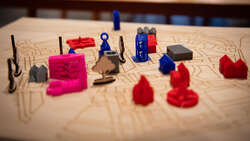
Kick off the Night with energy, curiosity, and music! Hosts of the Night will welcome you and share what makes this Groningen/European celebration of science so special. Researcher Mathilde Ficozzi unveils The Grounding AI Map, a spectacular walkable visualization that lets you explore how artificial intelligence shapes research. Then DJ-researcher Elizabeth Falade takes the stage to spark your imagination with her creativity and get the crowd moving to Afro-rooted rhythms. And to set the tone for an unforgettable evening, young band The Lay performs music composed especially for this Night - powerful, melodic, and full of heart.
Women’s Health is Human Health (ENG)
For a long time, medical research mostly looked at men. But women aren’t just smaller men – and that means they often don’t get the right healthcare. That needs to change.
Sara van de Lustgraaf talks with Paola Mian and Daniëlle van Veldhuizen about their research at UMCG. Do implants for a broken pelvis really work the same for men and women? What happens when women take medication during pregnancy? What risks are involved, and why do we still know so little? Find out how these researchers are tackling these gaps and making care better for women.
By: Paolo Mian & Danielle van Veldhuizen, UMCG
Host: Sara van de Lustgraaf
Materials of the Future (ENG)
Each era in the history of humanity has been defined by a particular material. We initially had the Stone Age, then the Bronze Age, after that the Iron Age, each of them defined by the technological advancements enabled by the discovery of such material. Since the invention of the first transistor in 1947 we entered the Silicon Age. Silicon is the semiconductor material at the heart of any electronic device currently in your possession, from your laptop to your smartphone to your electrical vehicle. However, after 80 years we might have reached the end of the Silicon Age. But then, what will be the material of our future?
By: Young Academy Groningen, Roberto Lo Conte, Faculty of Science and Engineering, RUG
It’s not about the result: learning in an AI-world (ENG)
AI tools like ChatGPT are turning the way we work and learn upside down—and will continue to do so. So what does that mean for the education of tomorrow? In this talk, Dr. Kai Yu Ma shares how we’re currently navigating AI in higher education, but more importantly, where we need to go next. AI promises greater efficiency and productivity, but what might we lose along the way? What about creativity, critical thinking, and reflection? In a time where everything moves faster, Dr. Kai Yu Ma argues for slowing down. So sit back and let’s talk about what education should look like in the age of AI.
By: Kai Yu Ma, Academic Teacher at UMCG
Auke-Florian Gets Nesty (NL)
What do underwear, stickers, and cocaine baggies have to do with animals? A lot, actually. Biologist Auke-Florian Hiemstra studies animal architecture—things made by animals—and in this lively theatre talk, he dives into the bizarre world of modern bird nests.
Animals no longer build with just twigs. In a world full of humans and trash, they use whatever they can find. So, what does that say about us—and what can we learn from them?
With humour and curiosity, Auke-Florian shares his weirdest nests and wildest discoveries—finds that made it into The New York Times and National Geographic. A surprising look at how animals build in the age of humans.
By: Auke Florian Hiemstra
Matilde Ficozzi - Creating Grounding AI (ENG)
Short presentations on the ground floor stage spark curiosity, from algorithms and ancient trash to the science of sound. On the Grounding AI stage, researchers link their work to the AI Map, inviting you to explore the evolving landscape of knowledge. Elsewhere, examine prehistoric waste under the microscope or enjoy our live DJ exploring music’s impact on wellbeing and society.
By: Matilde Ficozzi, Campus Fryslân, RUG
Circular Plastics (ENG)
The environmental impact of plastic is huge: mountains of waste, rising carbon emissions, and microplastics polluting our planet. And still, it’s everywhere. Why? Because it’s versatile, affordable, and durable. Recycling alone isn’t enough. The future demands innovation and new materials that can close the loop completely.
In this session we discover new technologies driving the revolution toward truly circular plastics, transforming waste into valuable resources and reshaping our world for a sustainable tomorrow.
By: Peter J. Deuss & Patrizio Raffa, ENTEG, Faculty of Science and Engineering, RUG
Host: Olaf Vos
Constellations of Art and Energy Transition (ENG)
Explore the stories of energy transition through art! As ancient people drew constellations
in the sky, artists and scientists connect the dots to go beyond imagination. Tonight in the
library area, art and energy transition meet in a large-scale monochrome installation —
scientific diagrams and object images from RUG are compiled into a dynamic art piece!
By: Sayoko Matsutani,Nasser Kalantar-Nayestanaki, art curator, Pine Valley Contemporary, ESRIG, Faculty of Science and Engineering, RUG
Host: Wilbert van de Kamp
Silent disco science battle (NL)
Listen to researchers presenting their stunning research findings while battling with each other for your attention!
Medication and the Placenta: How Drugs Reach the Fetus
Femke Elzinga, UMCG
Milk without cows
Owen Terpstra, Faculty of Science and Engineering, RUG
Better understanding a rare childhood disease
Alise de Groot, UMCG
Farming Sugar, Cultivating Salt (ENG)
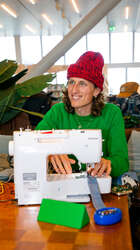
Farming Sugar, Cultivating Salt is an engaging, arts-based project where researchers explore new, more balanced cycles of sugar and salt — in our bodies and in the landscape.
In this workshop, you'll encounter two fascinating plants: the sea beet and the sugar beet. Though closely related, they’ve become opposites through human cultivation and agricultural practices.
Through storytelling and collective exercises, we’ll take you on an imaginative journey — from the salt-tolerant plants on the coastline to the sugar beet fields of Groningen and Friesland, after which we move to the many shapes and colors of sugar in the supermarket.
By: Ronald Boer, Jonmar van Vlijmen, Rosanne van Wijk, De Onkruidenier & Rimvydė Muzikevičiūtė, Campus Fryslân, RUG
Let the Body Move: Tracing Afro-Rooted Music (ENG)
In this DJ workshop, Elizabeth Falade takes you on a journey through the vibrant evolution of Afro-rooted music in the 21st century. From Afrobeat to Hip-Hop, R&B, amapiano and UK Garage, discover how global rhythms carry stories of resistance, joy and innovation.
Elizabeth crafts a set that reflects the music’s diasporic journey, blending tradition with technology. As bodies move and histories intersect, the workshop becomes a living archive, celebrating sound as a force of connection, identity, and transformation across borders and generations.
By: Elizabeth Falade, Faculty of Arts, UG
What's that sound? - What can songbirds teach us about speech acquisition? (NL)
Songbirds don’t learn to sing naturally; as young birds, they listen to examples in their
environment and practice their own sounds. In this special edition of Collector’s Items, Sanne
Moorman discusses how this process occurs in the avian brain: what can we learn from
songbirds about our own speech acquisition?
By: Sanne Moorman, Assistant Professor of Behavioral Neuroscience at the University of
Groningen.
This program is part of Collector’s Items, a program of Studium Generale and the
Universiteitsmuseum Groningen.
Grounding AI with Nataliia Laba (ENG)
Short presentations on the ground floor stage spark curiosity, from algorithms and ancient trash to the science of sound. On the Grounding AI stage, researchers link their work to the AI Map, inviting you to explore the evolving landscape of knowledge. Elsewhere, examine prehistoric waste under the microscope or enjoy our live DJ exploring music’s impact on wellbeing and society.
By: Nataliia Laba, Faculty of Arts, RUG
ACT UP! Theatre for Change (ENG)
In this workshop we invite you to actively engage with climate politics through a series of improvisational games. This power session will have you exploring how fun, play and theater can help overcome polarisation, embrace diverging points of view and make dialogue fruitful. Playful, and thought-provoking. No previous experience needed.
By: Marline Lisette Wilders & Marian Counihan, University College Groningen, RUG en Rudolf Agricola School for Sustainable Development, Salomé Attias, SPARK Rotterdam
How to face your climate future (ENG)
Do you sometimes worry about climate change, but then push the thought aside and just get on with your day? Maybe thinking about it feels too big, too heavy, or leaves you feeling powerless. In this session we’ll look at it from a fresh perspective. Together, we’ll explore ways to cope that work for you - and for the planet.
By: Leah Henderson, Rudolf Agricola School for Sustainable Development and Faculty of Philosophy, RUG
Neuromorphic Computers and AI
(NL)
A computer inspired by the human brain — lightning-fast, energy-efficient, and small enough to fit in your pocket. That’s what CogniGron is working on. With the rapid growth of AI, data traffic and energy use in data centres are skyrocketing, while current systems will soon struggle to keep up.
Neuromorphic computing offers an alternative: small, efficient, less dependent on Big Tech, and powerful enough to make AI available everywhere — without the massive energy demands of traditional systems. But with so much computing power at our fingertips, the question remains: will we use this technology to expand our capabilities, or will we let AI take over too many of our decisions?
By: Niels Taatgen, Faculty of Science and Engineering, UG
Book Launch: Queer and in Care (ENG)
Join the launch of Queer and in Care: Journeys through Care Being Young and
LGBTQIA+. This book explores what it means to grow up queer and in care, while also
finding strength in community, solidarity, and support. We hope it helps queer youth in care
feel seen, affirmed, and less alone. Written by a diverse team (care-experienced people,
students, professionals, and researchers across the spectrum of gender and sexuality), it
reflects our shared commitment to challenging inequality and building a more inclusive
world. Celebrate and amplify young queer voices at the European Researchers’ Night!
By: Mónica López López & Mijntje ten Brummelar, Faculty of Behavioural and Social Sciences, UG & Rodrigo Gonzalez Alvarez, University College, RUG
Host: Wilbert van de Kamp
How to recognize a destructive leader and what to do about them (NL)
It is the age of the strong men. Autocratic political leaders who believe themselves to be above the law. They are a danger to society and undermine democracy and yet they seem to rise to power everywhere. Why are they so appealing to us? Why do we follow them? What makes them so dangerous? Why should we be worried and what can we do about them? In this minilecture the focus will be on their rise to power and the followership they attract. It will discuss polarization, the rise of extremism and its underlying causes and the role of the internet.
By: Alette Smeulers, Faculty of Law, RUG
Music performance by: Katie Koss
Hosted by: Dzifa Kusenuh
What's that sound? - What causes tinnitus? (NL)
What actually happens when you no longer hear properly, but mainly hear a ringing or a noise?
In this special edition of Collector’s Items, Pim van Dijk explores the mechanisms responsible
for this. He also discusses the connection between hearing loss, tinnitus, and brain function.
By: Pim van Dijk, clinical physicist-audiologist at the University Medical Center Groningen
(UMCG). He conducts research on hearing and hearing problems, with a particular focus on
ringing in the ears (tinnitus).
This program is part of Collector’s Items, a program of Studium Generale and the
Universiteitsmuseum Groningen.
Grounding AI with Rolando Gonzales Martinez (ENG)
Short presentations on the ground floor stage spark curiosity, from algorithms and ancient trash to the science of sound. On the Grounding AI stage, researchers link their work to the AI Map, inviting you to explore the evolving landscape of knowledge. Elsewhere, examine prehistoric waste under the microscope or enjoy our live DJ exploring music’s impact on wellbeing and society.
By: Rolando Gonzales Martines, Faculty of Spatial Sciences, RUG
ACT UP! Theatre for Change (ENG)
In this workshop we invite you to actively engage with climate politics through a series of improvisational games. This power session will have you exploring how fun, play and theater can help overcome polarisation, embrace diverging points of view and make dialogue fruitful. Playful, and thought-provoking. No previous experience needed.
By: Marline Lisette Wilders & Marian Counihan, University College Groningen, RUG en Rudolf Agricola School for Sustainable Development, Salomé Attias, SPARK Rotterdam
Farming Sugar, Cultivating Salt (ENG)
Farming Sugar, Cultivating Salt is an engaging, arts-based project where researchers explore new, more balanced cycles of sugar and salt — in our bodies and in the landscape.
In this workshop, you'll encounter two fascinating plants: the sea beet and the sugar beet. Though closely related, they’ve become opposites through human cultivation and agricultural practices.
Through storytelling and collective exercises, we’ll take you on an imaginative journey — from the salt-tolerant plants on the coastline to the sugar beet fields of Groningen and Friesland, after which we move to the many shapes and colors of sugar in the supermarket.
By: Ronald Boer, Jonmar van Vlijmen, Rosanne van Wijk, De Onkruidenier & Rimvydė Muzikevičiūtė, Campus Fryslân, RUG
Astronomy on Tap: The Cherenkov Telescope Array (ENG)
Curious about the mysteries of the universe? Join us for a special edition of Astronomy on Tap at the Forum during the European Researchers’ Night. Prof. Dr. Manuela Vecchi will introduce the Cherenkov Telescope Array Observatory (CTAO), the most ambitious gamma-ray observatory yet, and explain what it can teach us about the cosmos. After the talk, take part in our interactive astronomy pub quiz and put your knowledge to the test!
Image credits: Credit: Gabriel Pérez Diaz (IAC)/Marc-André Besel (CTAO)/ESO/ N. Risinger.
Let Gronings make you happy (NL)
Are people who speak Gronings, a Low Saxon dialect, happier than the average Dutch person? You might not think so at first, but people from Groningen often say they feel happy and satisfied with, for example, the place where they live. Could speaking the Gronings dialect have something to do with that? And what if you are new to the province: could learning the dialect also contribute to a happier life? Or might it even boost your cognitive abilities in other areas?
Professor Merel Keijzer and Low Saxon dialect expert Olaf Vos will guide you into the happy world of Gronings. With music, science and a good dose of humor, you too can experience what it’s like to be a happier person through the Gronings dialect.
By: Olaf Vos, school psychologist and host Merel Keijzer, Faculty of Arts, UG
Foodways. Commensality (eating together) in the Middle East and its diasporas (ENG)
Food is more than nourishment — it carries memories, values, and traditions that connect people across generations and borders. This new book explores how culinary heritage in the Middle East and its diasporas shapes identities and brings communities together. At its heart is the idea of commensality — sharing (or not) a table while respecting differences. Discover how the table can a space of encounter, memory, and community, and why the Middle East’s rich food traditions matter for all of us today.
By: Karène Sanchez Summerer, Faculty of Arts, RUG and NINO (Netherlands Institute for Near East Studies)
Host: Wilbert van de Kamp
App-ocalypse (ENG)
WhatsApp, TikTok, Chrome, Google Maps, Excel and even ChatGPT – we use them every day and can hardly imagine life without them. But what if we had to? In this workshop, Oskar J. Gstrein and Elisabeth Wilhelm explore today’s most popular apps and services together with you: what are their pros and cons, which alternatives exist, and why aren’t these alternatives more widely adopted by the general public? In the end, participants will choose one alternative and explain their reasoning.
By: Oskar J. Gstrein, Campus Fryslân, Jantina Tammes School) & Elisabeth Wilhelm, Faculty of Science and Engineering, UG
Teaser: Prehistoric Waste Under The Microscope (ENG)
Short presentations on the ground floor stage spark curiosity, from algorithms and ancient trash to the science of sound. On the Grounding AI stage, researchers link their work to the AI Map, inviting you to explore the evolving landscape of knowledge. Elsewhere, examine prehistoric waste under the microscope or enjoy our live DJ exploring music’s impact on wellbeing and society.
By: Jos Kleijne, Faculty of Arts, RUG
What's that sound? - How does noise pollution impact our daily life? (ENG)
Anastasiia Krushynska leads a research group that studies the relationships between materials and their structure, and develops advanced materials with properties for medical applications, sound insulation, vibration damping, and robotics. In this special edition of Collector’s Items, she focuses on noise pollution in our daily lives and the associated health problems. From internal noise-reducing solutions to large-scale acoustic shields; how can we use modern technologies to address this problem?
By: Anastasiia Krushynska, Associate Professor of Wave Dynamics and Materials Science at
the University of Groningen.
This program is part of Collector’s Items, a program of Studium Generale and the
Universiteitsmuseum Groningen.
Grounding AI with Niels Taatgen (ENG)
Short presentations on the ground floor stage spark curiosity, from algorithms and ancient trash to the science of sound. On the Grounding AI stage, researchers link their work to the AI Map, inviting you to explore the evolving landscape of knowledge. Elsewhere, examine prehistoric waste under the microscope or enjoy our live DJ exploring music’s impact on wellbeing and society.
By: Niels Taatgen, Faculty of Science and Engineering, RUG
Climate Café (ENG)
The climate is heating up, and so is the conversation! Join the Hanze team of climate change enthusiasts for an engaging, interactive session where we unpack what’s happening to our planet — no doom, just dialogue (because climate conversations don’t have to be all gloom and glaciers). Expect lively discussions, a few good laughs and possibly some aha moments! Whether you’re a seasoned eco-warrior or just wondering why summers feel like saunas, this session is for you. Come curious. Leave climate-wise.
By: Allard Roest & Charné Theron, Water Knowledge Centre NoorderRuimte, Hanze
Host: Floor Kuiper
Astronomy on Tap: The Cherenkov Telescope Array (ENG)
Curious about the mysteries of the universe? Join us for a special edition of Astronomy on Tap at the Forum during the European Researchers’ Night. Prof. Dr. Manuela Vecchi will introduce the Cherenkov Telescope Array Observatory (CTAO), the most ambitious gamma-ray observatory yet, and explain what it can teach us about the cosmos. After the talk, take part in our interactive astronomy pub quiz and put your knowledge to the test!
Image credits: Credit: Gabriel Pérez Diaz (IAC)/Marc-André Besel (CTAO)/ESO/ N. Risinger.
The Hormone Blame Game (ENG)
Brain fog, (pregnancy) cravings, grumpiness and clumsy choices. It must be the hormones, right? In our society, hormones are often used to explain everything women feel and experience. But men have hormones too, and their levels shift more than most people realise.
How do hormones affect men and women differently throughout life, and how much do they influence the way we think and make decisions? What role do they play during adolescence and later in life, such as during andropause and menopause? And do hormones also have a part in the development of Alzheimer’s disease?
By: Niki Gervais, Faculty of Science & Engineering, RUG
Music performance by: Katie Koss
Hosted by: Dzifa Kusenuh
Flutter your hands (NL)
Why do people move their hands spontaneously when they speak? And what does it mean in a time when artificial intelligence and language models like ChatGPT are becoming increasingly influential?
In this mini-lecture, you will discover why spontaneous gestures are so important for how both adults and children understand each other and learn from one another.
By: Lisette de Jonge-Hoekstra, Faculty of Behavioural and Social Sciences, RUG
Satire, Colonialism, and the Environmental Urgency (ENG)
When we think of environmental problems, fossil fuels, plastics, and recycling often come to mind. But climate change and ecological breakdown are deeply political, entangled with capitalism, labor, class, gender, colonialism, and imperialism. This talk tells stories about the environmental impacts of Dutch imperial projects and settler colonialism in Palestine. It further explores how satire can offer not only sharp political critique but also emotional affordances in the face of environmental degradation and land expropriation.
By: Massih Zekavat, Faculty of Arts, RUG
Host: Wilbert van de Kamp
What Is Life? (ENG)
We see life all around us — in people, plants, animals. But what actually makes something alive? A rock and a baby might both be complex, but only one is alive. So where do we draw the line?
There are many scientific definitions of life, yet none fully capture its essence. And if we can’t clearly define it, how can we even begin to recreate it in the lab?
In this session, we invite you to explore the boundary between biology and chemistry. Discover how researchers are working to understand — and even build — life from scratch. Molecule by molecule.
By: Levy Charleston, Faculty of Science and Engineering, UG
Silent disco science battle (ENG)
Listen to researchers presenting their stunning research findings while battling with each other for your attention!
Strong Networks, Greener Farms
Stefano Bertorini, Campus Fryslân, RUG
Selling Your Soul for a Job
Michael Eigner. Faculty of Philosophy, RUG
Bio-inspired materials and robotics
Clement Chan, Faculty of Science and Engineering, RUG
From Beats to Brainwaves: How Music Shapes Health and Society (ENG)
Short presentations on the ground floor stage spark curiosity, from algorithms and ancient trash to the science of sound. On the Grounding AI stage, researchers link their work to the AI Map, inviting you to explore the evolving landscape of knowledge. Elsewhere, examine prehistoric waste under the microscope or enjoy our live DJ exploring music’s impact on wellbeing and society.
By: DJ of the Night - Groninger DJ Qingting (Herman Kuis)
Farming with Biodiversity (NL)
What does biodiversity actually mean in agriculture? Is it about having as many species as possible, protecting rare plants and animals, or creating a resilient system that can withstand challenges? In the Netherlands — where farmland covers more than half of the country — these are pressing and complex questions.
How can we ensure that our land produces food people want to eat, provides farmers with a fair income, and at the same time contributes to nature conservation?
At the PolderLab near Leiden, researchers and local residents work together on this challenge. They experiment with innovative ways of producing food, in and with the landscape. Come and discover how biodiversity could shape the agriculture of the future and how different ideas and perspectives might come together.
By: Pieter Lageerwaard, Faculty of Law UVA & Faculty of Behavioural and Social Sciences, RUG
Host: Olaf Vos
Art and AI: Rivals or Teammates? (ENG)
AI-generated art is on the rise and it’s stirring up heated debate. Many artists are concerned: their work is being used to train AI without permission, which feels like digital theft. They're worried about losing their creative role, the emotional depth of art being lost, and the blurred line of who gets credit for hybrid creations. This project offers a different take: human-AI collaboration. The artist creates the original piece, and AI is used to refine and enhance it. Creative control stays with the human, and AI becomes a tool rather than a threat helping to keep the spark of human creativity at the heart of the work.
By: Rolando Gonzales Martinez, Faculty of Spatial Sciences, UG
Host: Wilbert van de Kamp
What's that sound? - What is the psychological impact of soundscapes? (ENG)
People are more than objective decibel meters. How we experience sound is influenced by all sorts of factors, such as the context of the sound or our mood. As a result, the same sound can be pleasant at times, but very bothersome at other times. Kirsten will tell you more about how our ancient brains interact with modern soundscapes and how this affects our mental and physical health.
By: Kirsten van den Bosch, Assistant Professor at the Faculty of Behavioural and Social
Sciences at the University of Groningen.
This program is part of Collector’s Items, a program of Studium Generale and the Universiteitsmuseum Groningen.
Can art change hospital care? (NL)
Everyone will sooner or later face a hospital visit, though hopefully not because you partied a little too hard during the European Researchers’ Night. Healthcare professionals are there to help, but in daily practice they often face heavy workloads and mountains of administrative tasks. This can result in less attention and space for the patient and can even lead to burnout for the caregivers themselves.
To turn this around and make healthcare a place where human and emotional interaction comes first, the UMCG, in collaboration with Arts in Health, is currently running several pilots using art to promote compassionate care. No pills or injections, but music, theater, and visual arts to make care more human, warmer, and enjoyable—for both patients and professionals.
By: Barbara L. van Leeuwen, professor of Surgical Oncology, Hanneke van der Wal-Huisman, senior researcher and nurse and Kirsten Krans from Arts in Health Netherlands explain what the pilots look like and why they believe art can make a real difference in hospital care.
Grounding AI with Francesca Padovani (ENG)
Short presentations on the ground floor stage spark curiosity, from algorithms and ancient trash to the science of sound. On the Grounding AI stage, researchers link their work to the AI Map, inviting you to explore the evolving landscape of knowledge. Elsewhere, examine prehistoric waste under the microscope or enjoy our live DJ exploring music’s impact on wellbeing and society.
By: Francesca Padovani, Faculty of Arts, RUG
In this DJ workshop, Elizabeth Falade takes you on a journey through the vibrant evolution of Afro-rooted music in the 21st century. From Afrobeat to Hip-Hop, R&B, amapiano and UK Garage, discover how global rhythms carry stories of resistance, joy and innovation.
Elizabeth crafts a set that reflects the music’s diasporic journey, blending tradition with technology. As bodies move and histories intersect, the workshop becomes a living archive, celebrating sound as a force of connection, identity, and transformation across borders and generations.
By: Elizabeth Falade, Faculty of Arts, RUG

Imagine a world where food doesn’t have to be cooked in the traditional way but can be printed instead. Lizette Oudhuis demonstrates how 3D food printers can create dishes tailored to your personal preferences and needs. An athlete could get exactly the right amount of protein, while an elderly person could enjoy food that’s easier to chew. 3D food printing opens up new possibilities to make nutrition smarter, healthier, and more sustainable.
By: Lizette Oudhuis, Research Center Biobased Economy, Hanze

WhatsApp, TikTok, Chrome, Google Maps, Excel and even ChatGPT – we use them every day and can hardly imagine life without them. But what if we had to? In this workshop, Oskar J. Gstrein and Elisabeth Wilhelm explore today’s most popular apps and services together with you: what are their pros and cons, which alternatives exist, and why aren’t these alternatives more widely adopted by the general public? In the end, participants will choose one alternative and explain their reasoning.
By: Oskar J. Gstrein, Campus Fryslân, Jantina Tammes School, RUG & Elisabeth Wilhelm, Faculty of Science and Engineering, RUG

The Ukrainian-born Katie Koss (Katja Poltavets) is asoulful indie-popartist. With her sultry, jazzy voice, signature guitar playing, and melodic bass lines (think North Sea Jazz meets Lowlands), she takes listeners on a personal journey of freedom and self-love. Her artistry is a reflection of her inner growth, translating struggles and progress into relatable, emotional stories about feminism, ethnicity, and identity. Sometimes with a touch of self-deprecating humor, other times with raw vulnerability

What do underwear, stickers, and cocaine baggies have to do with animals? A lot, actually. Biologist Auke-Florian Hiemstra studies animal architecture—things made by animals—and in this lively theatre talk, he dives into the bizarre world of modern bird nests.
Animals no longer build with just twigs. In a world full of humans and trash, they use whatever they can find. So, what does that say about us and what can we learn from them?
With humour and curiosity, Auke-Florian shares his weirdest nests and wildest discoveries—finds that made it into The New York Times and National Geographic. A surprising look at how animals build in the age of humans.
By: Auke-Florian Hiemstra, Wiskunde en Natuurwetenschappen Instituut Biologie, Universiteit Leiden

The Lay, 5 men strong, 2 meters tall and 1 solid sound. Catchy songs and beautiful stories with a wistful touch. Founded in 2014 with a clear goal: to write truly beautiful songs and move people. The first EP, titled Dying Weight, was released in 2018. The Ripper is still a favorite among their earliest fans.
In 2024, their long-awaited debut album Room For Dreaming finally saw the light of day. Ten brand-new tracks with a fresh sound let you experience The Lay like never before. After ten years together, this album stands as a symbol of their love for music and for each other.

Dzifa loves connecting people and bringing stories to life. You might know her from presenting 3 op Reis, where she traveled the world in search of new perspectives. She also hosted the popular YouTube format Drugslab and worked on Spuiten en Slikken, exploring social issues related to sex, drugs, and the body. During the festival, Dzifa will host several talks in the Rabo Studio. Expect sharp questions, engaging conversations, and plenty of humor.